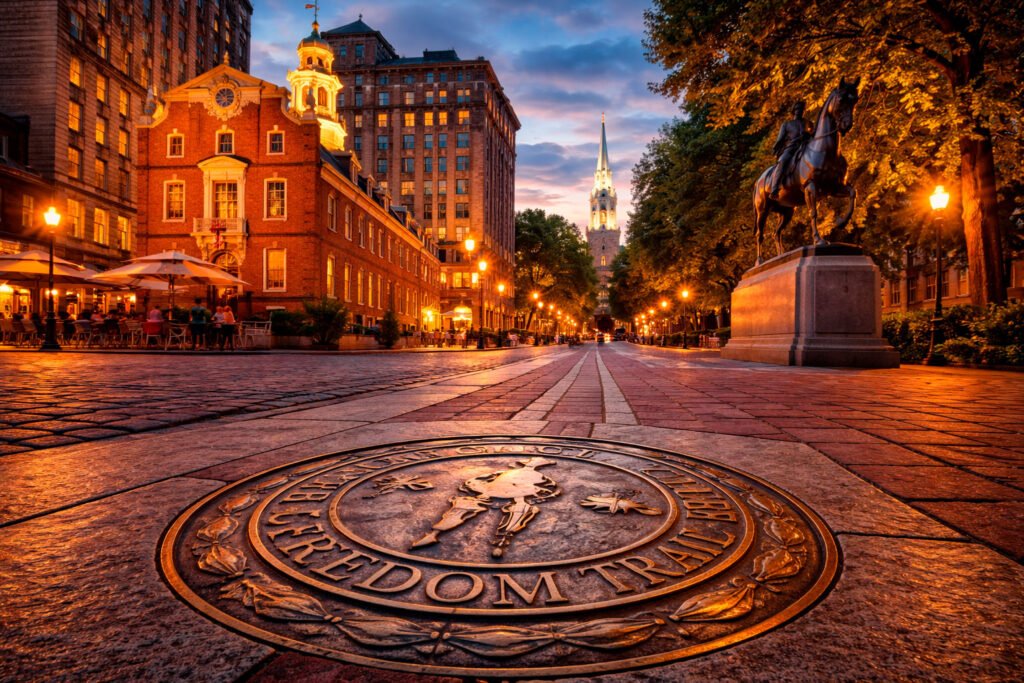

The Boston Freedom Trail
Walking Through America’s Revolutionary History
The Freedom Trail is one of Boston’s most iconic attractions — a 2.5-mile red-brick path that guides visitors through 16 historic sites that shaped the American Revolution.
Marked by a red line embedded in the sidewalks, the trail connects parks, churches, meeting houses, burying grounds, and landmarks that tell the story of America’s fight for independence.
Where It Begins
The trail starts at:
Boston Common
America’s oldest public park (est. 1634), which has served as a military camp, public gathering space, and civic meeting point for centuries.
Key Stops Along the Trail
Here are some of the most important sites:
Massachusetts State House
The gold-domed landmark overlooking Boston Common.
Park Street Church
A major site for abolitionist speeches.
Granary Burying Ground
Final resting place of Samuel Adams, John Hancock, and Paul Revere.
Faneuil Hall
Known as the “Cradle of Liberty.”
Paul Revere House
The colonial home of the patriot famous for his midnight ride.
Old North Church
“One if by land, two if by sea” — the signal that launched Paul Revere’s ride.
Bunker Hill Monument
Commemorating one of the first major battles of the Revolutionary War.
Why It Matters
The Freedom Trail is more than a tourist route — it is a journey through the birthplace of American democracy. It reflects themes of liberty, civic debate, resistance, and public voice — values that still define Boston today.
For a city preparing to host major global events like the 2026 FIFA World Cup, the Freedom Trail stands as a reminder that Boston has long been a stage for world-changing moments.
Visitor Information
Length: 2.5 miles
Time: 2–4 hours walking
Cost: Free to walk (some sites charge admission)
Best time: Spring, summer, and fall