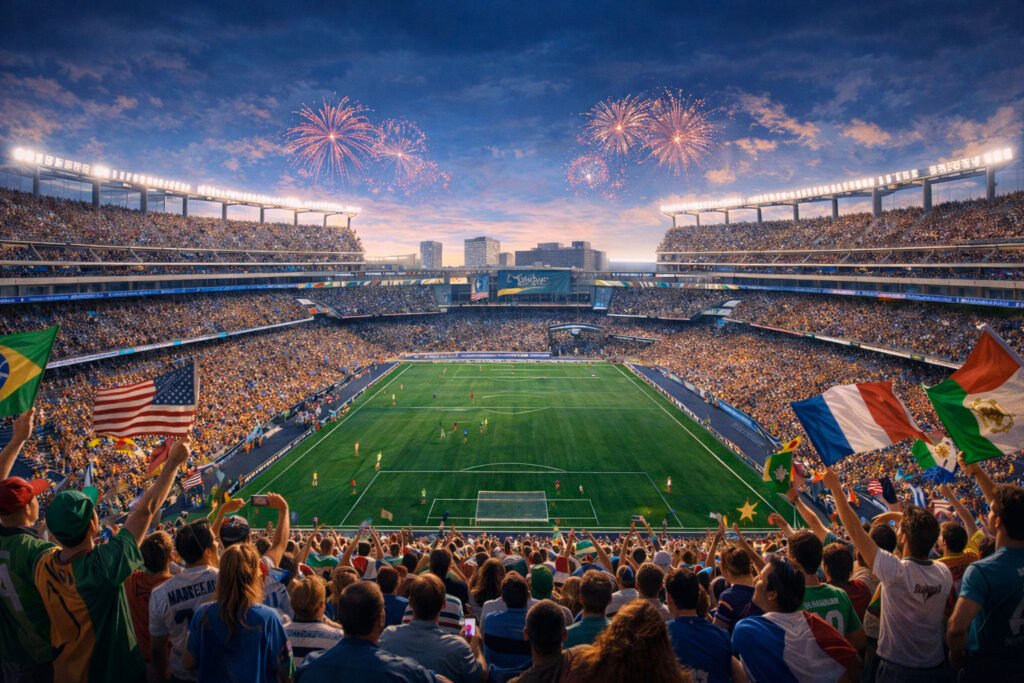

On March 26, 2026, two of the most decorated national teams in world football met on American soil: Brazil vs. France at Gillette Stadium.
What was positioned as a high-profile international friendly—part of the Road to 26 series leading into the FIFA World Cup 2026—became something far greater: a powerful demonstration of community, culture, and global readiness in Massachusetts.
More Than a Match: A Cultural Milestone
With an official attendance of **66,216 fans—predominantly Brazilian—**the match delivered a clear and undeniable message:
Massachusetts is home to a deeply rooted and highly engaged Brazilian community, representing approximately 500,000 residents across the state.
The stadium was transformed into a sea of Brazilian colors, chants, and identity—creating an atmosphere that felt closer to a World Cup match than a friendly.
This was not just a game.
It was a visible affirmation of the strength, organization, and cultural presence of one of the most vibrant immigrant communities in the United States.
Gillette Stadium: Proven on the Global Stage
As the home of the New England Patriots and New England Revolution, Gillette Stadium once again demonstrated its ability to host world-class events.
The March 26 match confirmed:
- Seamless handling of a 65,000+ international crowd
- High-level broadcast and media execution
- Strong security and operational performance
It served as a live, full-scale preview of what the venue will deliver when it hosts matches during the 2026 World Cup (when it will be referred to as “Boston Stadium” for FIFA branding purposes).
A Historic Rivalry, Revisited
Brazil vs. France is never just a friendly—it is a rivalry shaped by decades of World Cup history:
- 1986: France eliminated Brazil in a dramatic penalty shootout
- 1998: France defeated Brazil in the World Cup Final
- 2006: France once again eliminated Brazil in the quarterfinals
This latest encounter carried that same emotional weight, serving as a final competitive benchmark just months ahead of the World Cup.
Boston’s Multicultural Power on Display
The match highlighted something unique about Boston and its surrounding region:
A multicultural ecosystem capable of delivering global-scale experiences.
In addition to the Brazilian presence, the event brought together:
- French and Francophone communities
- Portuguese-speaking populations across Massachusetts
- International fans traveling from across the Northeast
The result was a multilingual, high-energy atmosphere that mirrored what is expected during the World Cup itself.
Economic and Strategic Impact
Beyond the stadium, the event generated significant regional impact:
- Increased hotel occupancy across Greater Boston
- High activity in restaurants, nightlife, and local businesses
- Extensive media exposure for Massachusetts as a global destination
For sponsors and partners, Road to 26 proved to be more than a sporting event—it was a platform for global positioning ahead of 2026.
A Preview of What’s Coming in 2026
Most importantly, March 26, 2026, served as a real-world introduction to what is about to come.
It functioned as:
- A live operational rehearsal
- A transportation and infrastructure stress test
- A broadcast production showcase
- A cultural activation at scale
When the final whistle blew, one thing was clear:
Massachusetts is not preparing for the World Cup—it has already begun living it.